Forms of Silence - Why Do Barbara Hepworth’s Sculptures Feel So Calm?
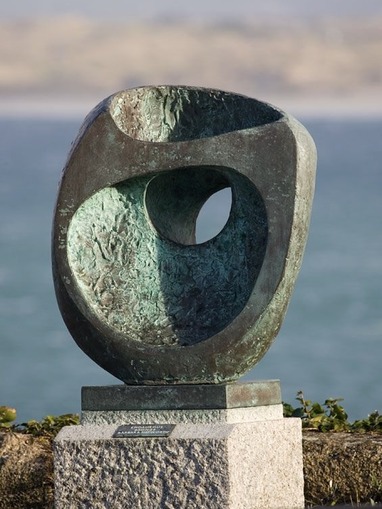
On Barbara Hepworth’s bronze sculptures, light always catches the smooth, polished curves first. Only after a closer look do the darker layers begin to emerge: oxidised recesses, subtle irregularities, duller areas of metal. After a while, the viewer stops looking at the form itself and begins watching the way sunlight moves across the bronze surface.
These works do not readily surrender to a visual culture built on speed, where images are consumed in fractions of a second. Hepworth’s sculptures demand a slower pace. They need to be circled, observed from different angles. You notice how a curve narrows, how deeply an opening extends into the form, where the material has been deliberately left rough. Some sculptures seem almost to awaken the sense of touch. They feel like river stones that have been turned smooth over years in the palm of a hand.
Cornwall’s Rocks and the Storm of Modernism
Although these monumental bronzes are now among Hepworth’s best-known works, this particular way of seeing began much earlier, rooted in the landscapes of rural Britain.
Born in Yorkshire in 1903, Hepworth spent the 1930s searching for her direction in London. When the Second World War broke out, she moved to the coastal town of St Ives in Cornwall. By the late 1940s, this isolated fishing village had become one of the most vibrant intellectual refuges of international modernism. Painters and sculptors worked side by side, and the rugged coastline, endless horizon and constantly shifting light left a profound mark on Hepworth’s practice.
Much of abstract art at the time was moving towards pure geometry and a kind of engineering precision. One only has to think of Piet Mondrian’s strict black lines and primary colours, or Naum Gabo’s transparent constructions that often resemble mathematical models. Hepworth approached many of the same questions from an entirely different direction.
There is something familiar in her rounded forms. It is easy to think of rocks shaped by wind, stones worn smooth by water, or other natural formations.
Several sculptors of the period explored similar ideas. Jean Arp’s biomorphic forms and Henry Moore’s hollowed figures still appear as natural points of comparison whenever Hepworth’s name is mentioned. Yet despite their close relationship, these works are rarely mistaken for one another. Hepworth’s sculptures tend to feel lighter. They draw attention less to their mass and more to the space that surrounds them.
The Hole as Presence
Hepworth remained deeply committed to the practice of direct carving. She carved and shaped stone and wood herself; physical labour was an essential part of the process. That struggle is still visible on the surfaces today.
She was never interested in sterile perfection. Alongside highly polished sections, her stone sculptures often retain raw, untouched areas. At times, the forms seem as though they are still connected to the original block from which they emerged.
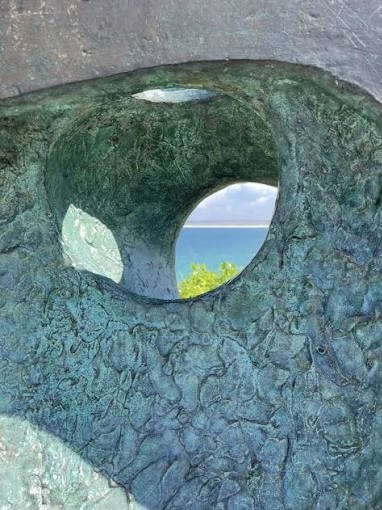
Yet perhaps her most radical innovation came in the 1930s, when she began piercing her sculptures. Classical academic sculpture had rarely treated emptiness in this way. In Hepworth’s work, openings gradually became defining elements of the composition.
Standing before a Hepworth sculpture, the eye almost instinctively moves towards these openings. They make the boundaries of the form feel less final. Air enters. Light enters.
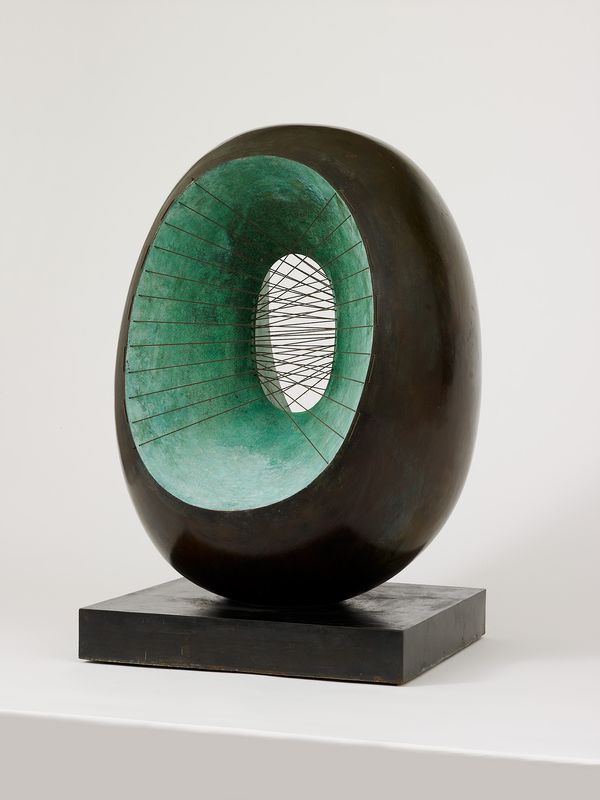
In some later works, she stretched fine strings across these openings. Like the strings of a musical instrument, they introduce a delicate geometric tension into the rounded masses.
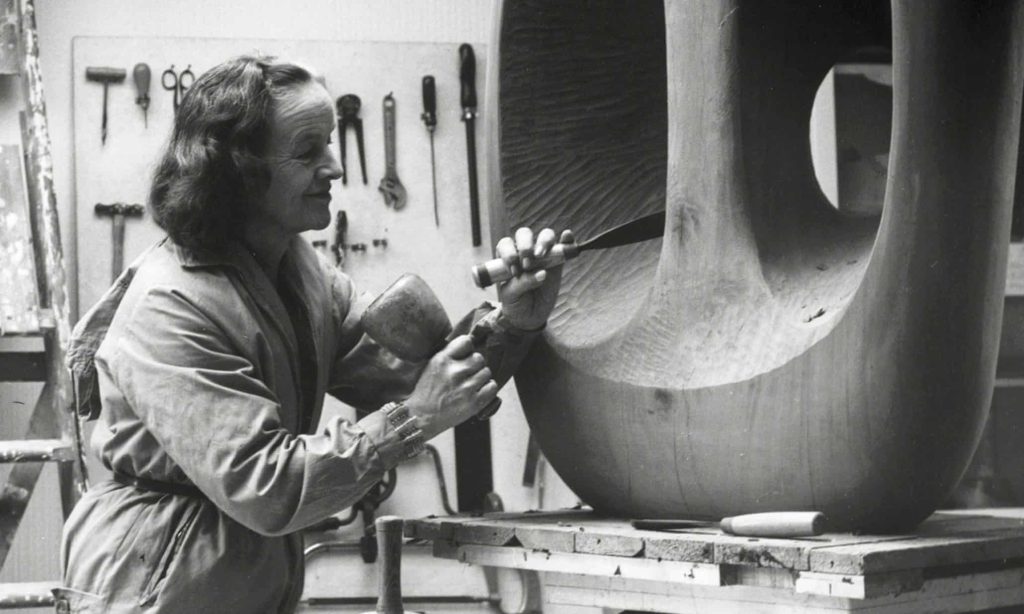
In old photographs of her studio, Hepworth stands among enormous blocks of wood, dressed in a dusty work coat, chisel in hand. Looking at the elegance of the finished sculptures, it is easy to forget how physical the process of carving really was.
The stone never stopped being stone.