Brigitta Barczi Jewellery

A curated space of art, objects and culture

Why Do Sculptural Jewellery Pieces Feel Different?

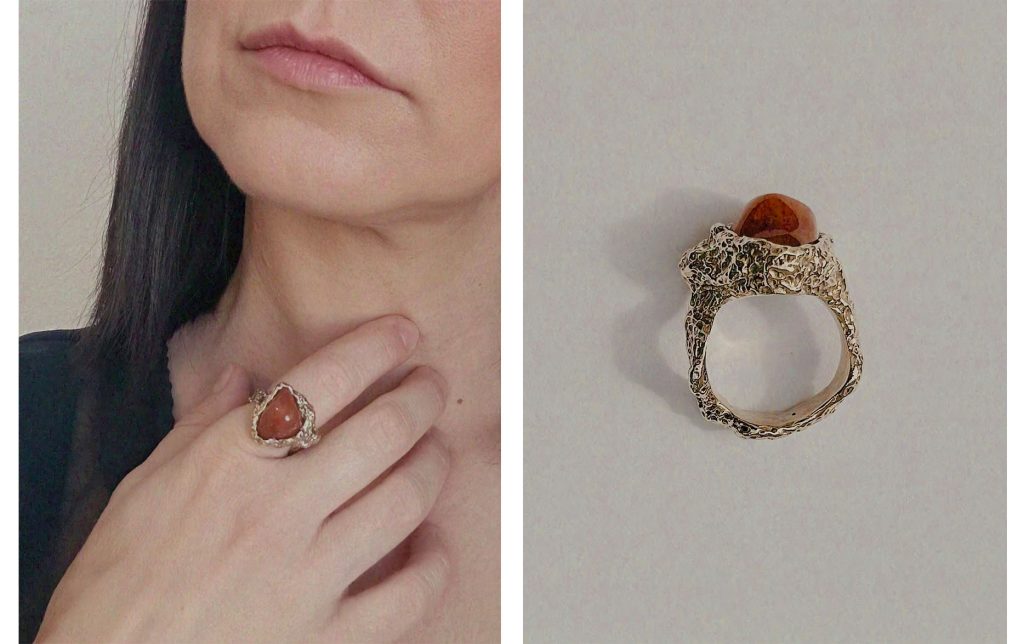
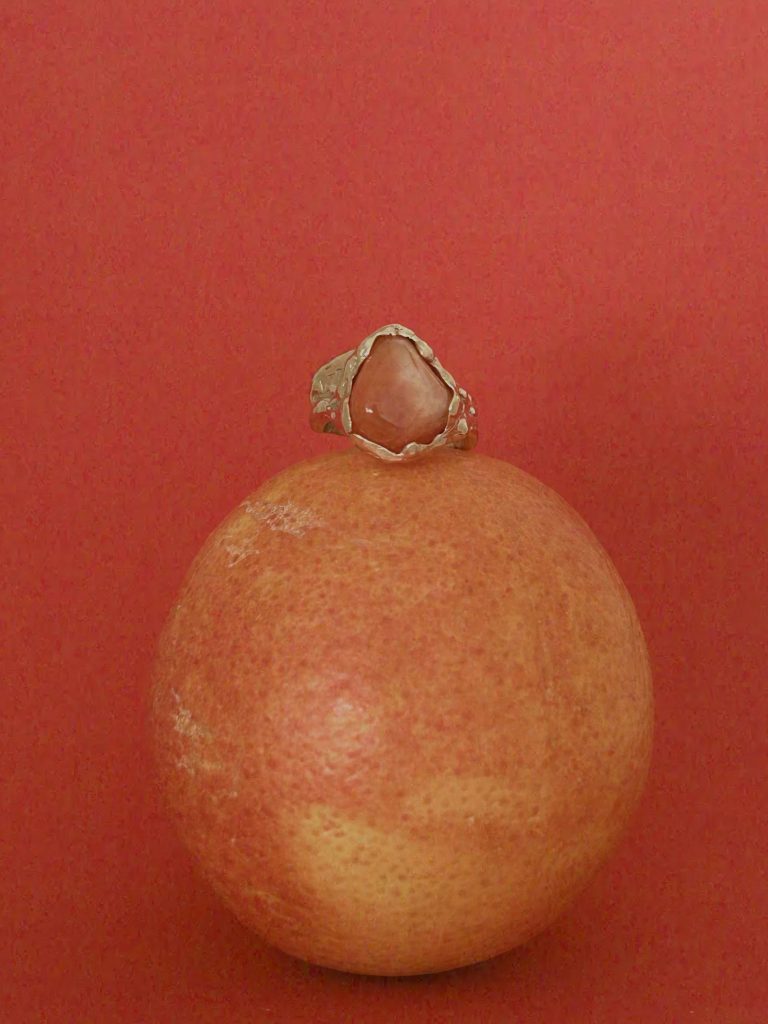
Sculptural statement ring with carnelian

A heavy ring changes the way a hand moves.

Not dramatically. Just enough to make someone become more aware of their hands. A wider form slows the movement of the fingers, while a raw surface keeps drawing the eye back for another look. Some jewellery pieces do more than decorate the body. They subtly alter its presence.

We often describe these objects as sculptural jewellery.

The term is widely used today, yet it remains surprisingly difficult to define what actually makes a piece feel sculptural. An organic shape alone is not enough. Neither is a larger scale. And a piece does not become interesting simply because it appears more “artistic”. The difference usually lies elsewhere: in the way it relates to the body, to material, and to attention itself.

It Does Not Begin as Decoration

Historically, jewellery was often connected to status, representation, or ornamentation. Perfectly cut gemstones, symmetry, and highly polished precious metals functioned as cultural signals for centuries. They communicated wealth, refinement, and social position.

Contemporary sculptural jewellery tends to search for different kinds of emphasis. Rather than seeking to shine, it seeks to exist. It has weight, proportion, and texture. At times, it feels closer to a small-scale sculpture or a found object than to jewellery in the traditional sense.

This way of thinking became more visible during the middle of the twentieth century, when the boundaries between sculpture, craft, and object design began to soften. Many artists became less interested in perfect surfaces and more interested in the behaviour of materials. Form was no longer treated as a predetermined outcome, but as something that emerged gradually through process.

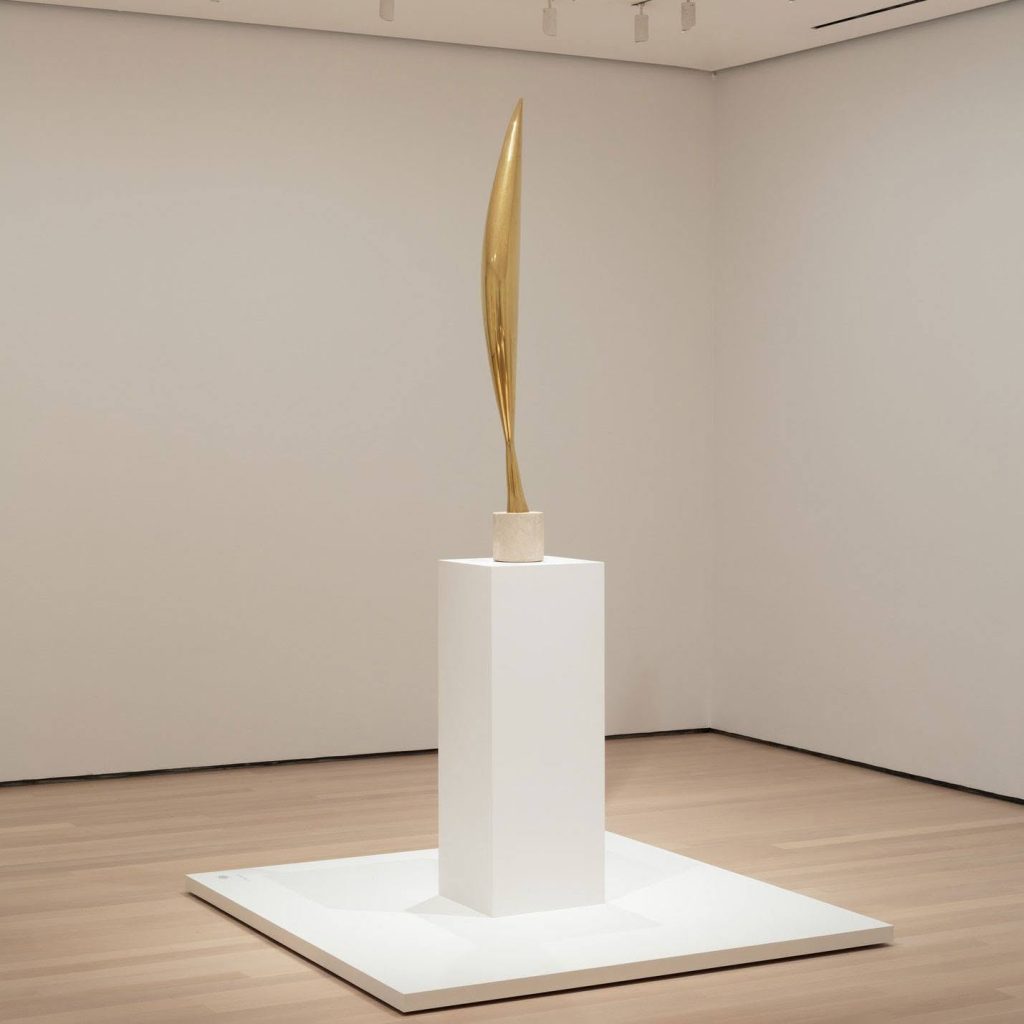
brancusi bird in space 1928
Constantin Brâncuși: Bird in Space, 1928. Over a period of more than twenty years (1923–1943), Brâncuși repeatedly returned to the same formal question: how to convey the sensation of flight without depicting a bird itself.

The work of Constantin Brâncuși remains an important precursor. His sculptures progressively shed their descriptive qualities. In the Bird in Space series, for example, we no longer encounter the details of a bird, but a single ascending curve that condenses the sensation of movement and flight. The focus shifts from recognisable subject matter to the internal logic of form.

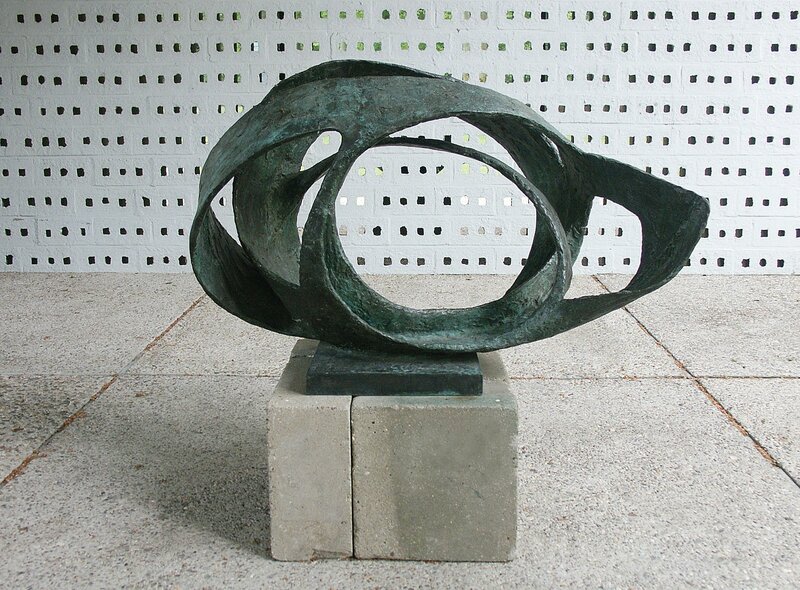
A similar interest can be found in the work of Barbara Hepworth. In her sculptures, absence becomes as important as mass. Beginning in the 1930s, she regularly pierced her forms, turning openings into central compositional elements rather than secondary details. Light, air, and surrounding space became active participants in shaping the work, alongside stone and bronze.

Barbara Hepworth Oval Form (Trezion), 1961-1963

These ideas remain visible in much contemporary jewellery today. Not as direct quotations, but as a way of thinking through form. In irregular circles, molten surfaces, asymmetrical proportions, and forms that seem less finished than still in the process of becoming.

The Strange Familiarity of Organic Forms

There is something curious about the way people often respond to slightly irregular forms. They tend to feel more approachable than perfect geometry.

Perhaps because true symmetry is relatively rare in nature. The course of a river, the erosion of stone, or the surface of a shell all emerge through gradual change. Time, pressure, movement, and chance shape them.

The work of Isamu Noguchi reflects this sensitivity particularly well. His sculptures and furniture feel both natural and precise. The paper forms of the Akari lamps and his biomorphic stone sculptures are not built around geometric perfection, but around the sense that a form has arrived at its final shape almost on its own. In many of his works, it is difficult to determine whether an object belongs more to design or to sculpture.

A similar quality can appear in jewellery. An earring is never entirely static. The movement of the body continuously alters form, light, and proportion. The surface of a ring looks different in morning light than it does in the evening. An asymmetrical object cannot be fully absorbed in a single glance.

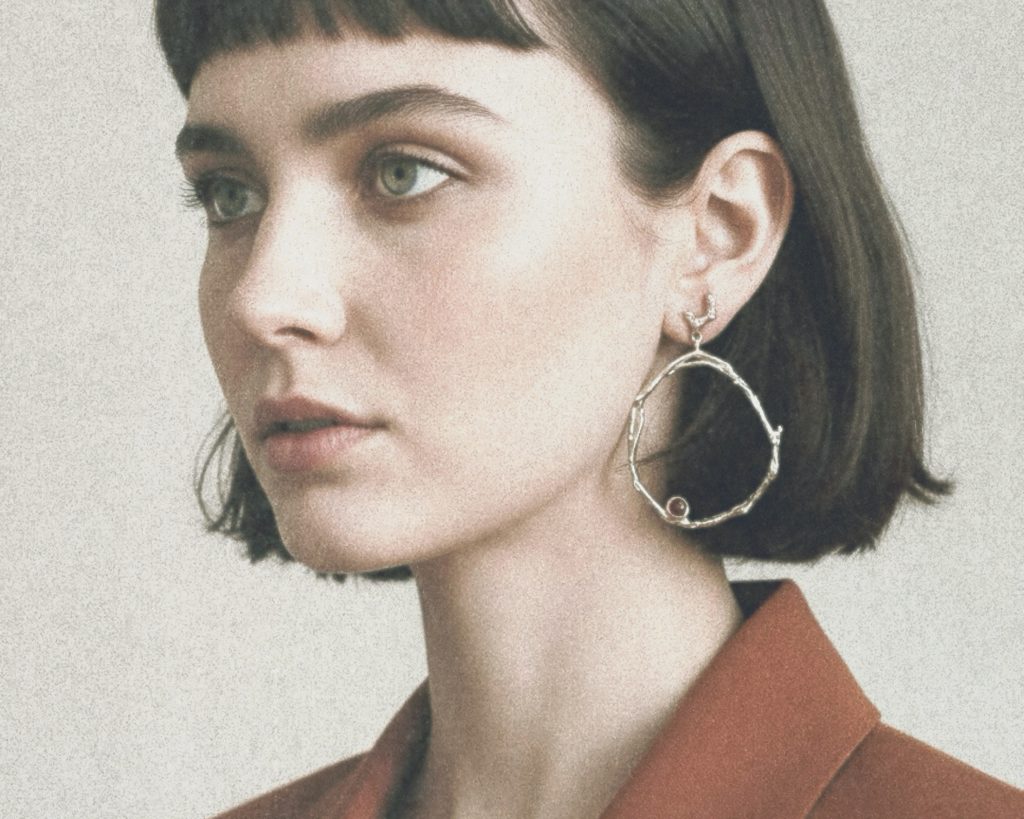
statement earrings with organic surfaces

Sometimes the Surface Matters More Than the Shape

Texture is one of the most compelling aspects of sculptural jewellery. In many cases, it defines the character of an object more strongly than its silhouette.

Highly polished surfaces reflect light cleanly. They feel smooth, elegant, and controlled. A raw or oxidised surface behaves differently. It creates shadows. It adds depth. It feels closer, more tactile.

Sometimes the metal resembles a miniature landscape.

This is one reason why lost-wax casting has become such an important technique for many contemporary jewellers. The process allows form to emerge in a less sterile way. Marks left by wax, the movement of molten metal, and small irregularities often remain visible in the final object.

These traces preserve something of the making process itself. They suggest that the material did not simply execute a plan, but participated in the shaping of the form.

This way of thinking has long been present in Japanese object culture. The concept of wabi-sabi is often reduced to the idea of “imperfect beauty”, though it is really a much more complex relationship with time and material. Wear, patina, and irregularity are not treated as flaws, but as evidence that an object has lived a real life.

Organic sculptural jewellery arranged in an editorial object composition

The Body Completes the Object

It is difficult to fully separate sculptural jewellery from the body. Such objects can function in a gallery or in a photograph, but they become truly alive through movement.

A heavier earring turns more slowly while walking. A wider ring changes the perception of space between the fingers. A necklace follows the rhythm of breathing.

At that point, the jewellery no longer functions as an isolated object. It forms something together with the body.

This may be one of the most significant differences between sculpture and jewellery. Sculpture generally exists on its own. Jewellery always remains connected to someone: to skin, gestures, posture, and use.

Over time, that relationship becomes visible. Metal wears gently. Surfaces change. The object gradually adapts to its wearer. For many sculptural jewellery pieces, this is part of their appeal: they do not remain entirely unchanged.

My cart
Your cart is empty.

Looks like you haven't made a choice yet.